Article Body
Indian Stock Market Ends Flat After Volatile Session as Tech and Telecom Stocks Support Recovery
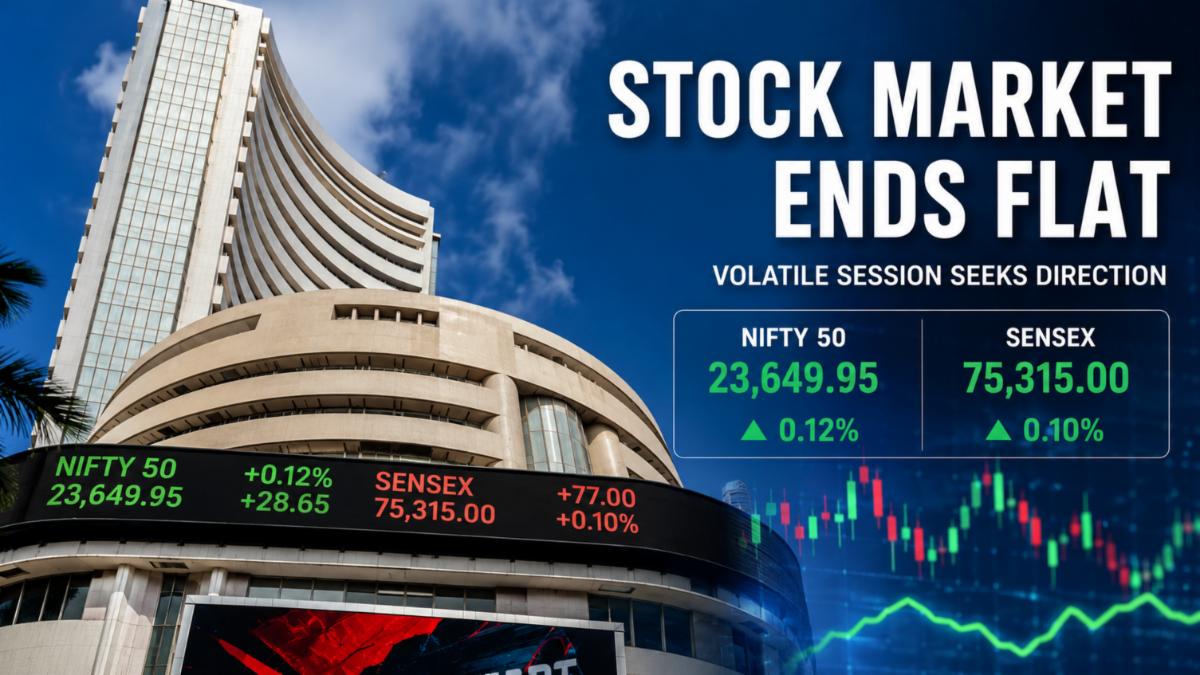
India’s benchmark equity indices witnessed a dramatic trading session on Tuesday, swinging sharply between gains and losses before ending almost unchanged. The volatility reflected growing investor caution amid mixed global cues, profit booking in heavyweight sectors, and uncertainty around foreign institutional flows.
The NSE Nifty 50 managed to close marginally higher at 23,649.95, while the BSE Sensex settled 77 points higher at 75,315 after recovering from deep intraday fluctuations. Market participants described the session as a “tug-of-war” between bullish momentum in technology and telecom shares and weakness in banking and metal stocks.
The day’s movement highlighted the fragile sentiment currently dominating Dalal Street, where investors are balancing optimism around India’s economic resilience with concerns over global inflation, oil prices, and foreign market instability.
Early Selloff Shakes Market Confidence
Trading began on a cautious note as investors reacted to weak Asian market trends and rising uncertainty in global financial markets. Heavy selling pressure in banking and metal stocks dragged both benchmark indices into negative territory during the first half of the session.
Shares of State Bank of India (SBI) and Tata Steel emerged among the biggest laggards of the day, contributing significantly to the market decline. Banking stocks faced pressure due to concerns around credit growth and global interest rate expectations, while metal shares weakened amid fears of slowing international demand.
Several traders also pointed toward cautious positioning ahead of upcoming macroeconomic data and foreign investment trends.
By midday, the Sensex had witnessed sharp swings of several hundred points, reflecting the nervous mood among institutional investors.
Infosys and Bharti Airtel Trigger Late Recovery
Despite the early weakness, the market staged a strong recovery in the second half of trading, led primarily by gains in technology and telecom stocks.
Infosys attracted significant buying interest after investors turned optimistic about the long-term outlook for India’s IT sector despite global slowdown concerns. Analysts noted that technology companies continue to benefit from strong digital transformation demand worldwide, even as short-term uncertainty persists.
Bharti Airtel also witnessed robust gains, helping improve overall market sentiment. Telecom stocks remained in focus after continued optimism around rising data consumption, subscriber growth, and stable revenue expectations in India’s rapidly expanding digital economy.
The combined strength of these heavyweight stocks helped benchmark indices recover most of their earlier losses before the closing bell.
Market strategists said the recovery demonstrated that investors are still willing to selectively buy quality large-cap stocks during periods of volatility.
Banking and Metal Stocks Continue Facing Pressure
While technology and telecom sectors supported the market, weakness in financial and metal stocks restricted further upside.
State Bank of India shares remained under pressure throughout the session, reflecting broader concerns in the banking sector regarding margin pressures and foreign fund outflows from financial stocks.
Metal companies, including Tata Steel, also struggled due to weakness in global commodity prices and uncertainty surrounding international industrial demand.
Commodity-linked sectors have recently faced volatility as investors closely monitor economic data from China, Europe, and the United States.
Analysts believe cyclical sectors may continue experiencing short-term pressure if global growth concerns intensify further.
Foreign Investors Remain Key Market Driver
Foreign Institutional Investors (FIIs) continue to play a major role in determining short-term market direction. Recent fluctuations in global bond yields and strengthening of the US dollar have influenced investment flows across emerging markets, including India.
Market experts say foreign investors remain cautious due to rising geopolitical tensions, global inflation risks, and uncertainty around future interest rate decisions by major central banks.
However, domestic institutional buying has helped absorb part of the selling pressure, preventing deeper market corrections in recent sessions.
Retail participation in Indian equities also remains relatively strong, reflecting long-term confidence in the country’s economic growth story.
Volatility Reflects Broader Global Uncertainty
Today’s sharp intraday swings mirrored broader uncertainty across international markets. Investors worldwide are currently navigating multiple economic concerns simultaneously, including:
- Rising crude oil prices
- Global inflation pressures
- Interest rate uncertainty
- Geopolitical tensions
- Slowing industrial growth in key economies
Indian markets have shown resilience compared to several global peers, but analysts warn that volatility could remain elevated in the near term.
Many traders are adopting stock-specific strategies instead of aggressive broad-market bets, focusing on sectors with stable earnings visibility and long-term growth potential.
Experts See Consolidation Phase in Markets
According to market analysts, Indian equities may currently be entering a consolidation phase after witnessing strong rallies in previous months.
During consolidation periods, benchmark indices often move within a narrow range while investors assess earnings performance, economic indicators, and global developments before taking fresh positions.
Experts believe sectors such as information technology, telecom, infrastructure, and capital goods may continue attracting investor attention due to long-term structural growth opportunities.
At the same time, rate-sensitive sectors including banking, real estate, and metals could remain volatile depending on interest rate expectations and global commodity trends.
Retail Investors Advised to Stay Selective
Financial advisors continue urging retail investors to avoid panic-driven decisions during volatile trading sessions.
Many wealth managers recommend focusing on fundamentally strong companies with healthy balance sheets and sustainable earnings rather than reacting to short-term market swings.
Long-term investors are also being advised to diversify portfolios across sectors to reduce risk exposure during uncertain market conditions.
Market veterans say volatility often creates opportunities for disciplined investors willing to remain patient during temporary corrections.
Outlook for the Coming Sessions
Investors will now closely monitor upcoming domestic economic data, global market movements, crude oil prices, and foreign investment trends for further direction.
Corporate earnings announcements and commentary from major global central banks are also expected to influence market sentiment in the coming days.
For now, Tuesday’s session reflected a market struggling to find clear direction — balancing optimism around India’s long-term growth prospects against rising global economic uncertainty.
While benchmark indices ended almost flat, the sharp swings throughout the day served as another reminder that volatility continues to dominate the Indian stock market landscape.

Comments