Banks Eye Massive Infrastructure Lending as India’s Hospitality Sector Attracts Fresh Investment Momentum
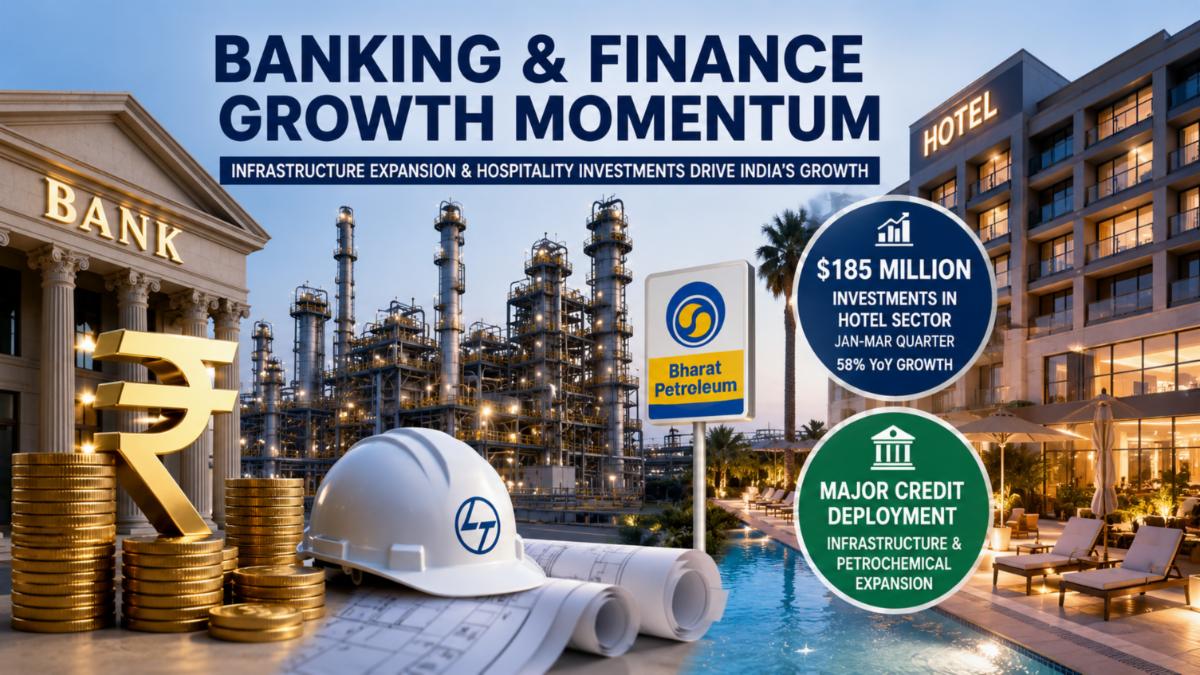
India’s banking and financial ecosystem witnessed strong momentum this week as large-scale infrastructure financing and hospitality investments signaled growing confidence in the country’s long-term economic expansion story.
Public sector lenders and major commercial banks are closely tracking Larsen & Toubro (L&T) after the engineering giant secured a major order from Bharat Petroleum Corporation Limited (BPCL) to build what is expected to become India’s largest flexible petrochemical facility. At the same time, India’s hotel and hospitality industry reported a sharp rise in investment activity during the January–March quarter, reflecting renewed investor appetite in tourism-linked assets.
The twin developments underline how infrastructure and hospitality are emerging as two of the most closely watched sectors in India’s broader capital deployment cycle.
L&T’s BPCL Project Signals Major Infrastructure Credit Demand
Larsen & Toubro’s onshore business vertical recently bagged a significant engineering and construction order from BPCL tied to a large petrochemical expansion project.
According to The Economic Times, the proposed facility is expected to become India’s largest flexible petrochemical plant, capable of processing multiple feedstock configurations to improve operational efficiency and output diversification.
The scale of the project is already drawing attention across India’s banking sector because of the substantial financing and credit requirements typically associated with large industrial infrastructure projects.
Banking analysts say such mega-capex projects often generate long-term opportunities for lenders across project financing, working capital support, syndicated loans, and supplier ecosystem funding.
Why Banks Are Watching the Project Closely
Large industrial and petrochemical projects generally require multi-layered financing structures involving public sector banks, private lenders, and institutional funding participation.
According to Moneycontrol, Indian banks have recently increased focus on infrastructure-linked lending as corporate balance sheets improve and government-backed industrial expansion accelerates.
The BPCL-L&T project is also seen as strategically important for India’s downstream energy and petrochemical sector, which continues witnessing increased investment amid rising domestic consumption demand.
Industry experts believe the project may support broader industrial ecosystem growth through logistics, manufacturing supply chains, construction contracts, and employment generation.
Petrochemical Expansion Reflects India’s Industrial Push
India’s petrochemical sector has become one of the country’s most important industrial growth engines due to rising demand from packaging, automotive, infrastructure, textiles, and consumer goods industries.
Flexible petrochemical plants are particularly valuable because they can adapt production based on changing raw material economics and market demand patterns.
Energy market experts told Reuters that integrated refining and petrochemical capacity expansion remains a major strategic priority for Indian energy companies seeking long-term growth opportunities.
The project also aligns with India’s broader manufacturing and industrial expansion goals as the country aims to strengthen domestic production capabilities and reduce import dependency in several chemical and industrial categories.
Hospitality Sector Sees Strong Investment Recovery
Alongside industrial financing activity, India’s hospitality sector also recorded strong investment growth during the January–March quarter.
According to a new report released by JLL India, the country’s hotel and hospitality sector attracted nearly $185 million in investments during the quarter, representing a sharp 58% year-on-year increase.
The report highlighted that portfolio acquisitions, land monetization strategies, and renewed investor confidence played major roles in driving the investment surge.
Industry observers say the recovery reflects strengthening optimism around India’s tourism, business travel, and premium hospitality markets following years of pandemic-related disruption.
Investor Confidence Returns to Hospitality Assets
Hotel assets across major Indian cities have increasingly attracted institutional investors, real estate funds, and hospitality operators seeking exposure to the country’s growing travel economy.
According to Business Standard, improving occupancy rates, rising average room prices, and expanding domestic tourism demand have helped revive investor sentiment in the sector.
Several hospitality companies are also exploring asset-light expansion strategies while landowners increasingly monetize high-value urban properties through hotel partnerships and redevelopment projects.
Industry experts believe India’s hospitality industry could continue benefiting from rising corporate travel, international tourism recovery, wedding tourism, and large-scale event demand.
Real Estate and Tourism Linked Growth Accelerates
The hotel investment recovery also highlights the broader rebound taking place across India’s real estate and tourism-linked economy.
Premium hotel developments, mixed-use projects, and luxury hospitality properties are increasingly becoming attractive long-term investment categories for institutional capital.
As reported by Bloomberg, India remains one of the fastest-growing major travel markets globally, supported by rising middle-class spending, improving infrastructure, and expanding domestic air connectivity.
Financial analysts say hospitality investments often act as indicators of broader economic confidence because the sector closely reflects business activity, consumer spending, and tourism trends.
Banking Sector Continues Infrastructure-Focused Expansion
India’s banking sector has gradually shifted back toward infrastructure and industrial financing after years of focusing heavily on retail lending and balance-sheet repair.
Improved asset quality, stronger corporate profitability, and government-led capital expenditure initiatives have encouraged lenders to re-enter large-scale project financing more aggressively.
Public sector banks, in particular, are expected to play a major role in supporting infrastructure expansion linked to energy, transportation, manufacturing, and urban development.
Analysts tracking the sector say projects like BPCL’s petrochemical expansion could become important drivers for long-term credit growth across India’s banking system.
India’s Capital Investment Cycle Gains Momentum
Together, the BPCL-L&T petrochemical project and the hospitality sector investment surge point toward a broader revival in India’s capital investment environment.
Infrastructure, industrial manufacturing, tourism, and real estate are increasingly emerging as key pillars of economic growth as investors and lenders reposition for long-term opportunities.
Economists believe sustained capital deployment across these sectors could support employment generation, private investment growth, and broader economic expansion over the coming years.
For financial markets, the message is becoming clearer: India’s next growth phase may be increasingly driven by large-scale infrastructure development and rising domestic consumption-led sectors like hospitality and travel.